- Color Game
- Color Matching
- Color Guessing
- Design Games
Color Method Game: Master Hue, Saturation & Harmony Matching
Color method: match hue and saturation, then name complementary and triadic pairs. Concrete rounds, not vague color theory tips.

Sherotree
·9 min read
If you've ever tried to match a brand color by eye in Figma and ended up three hex codes away from where you started, Color method is the practice tool you need. It's a free matching color game where you adjust hue and saturation to hit target swatches, then progress into complementary, analogous, triadic, and tetradic harmony rounds. It turns color guessing into a measurable skill. Start playing Color method now →
This guide covers how the game works, the harmony topics it teaches, practical tips to score higher, and how the same skills transfer to real design work.
What is the Color method game?
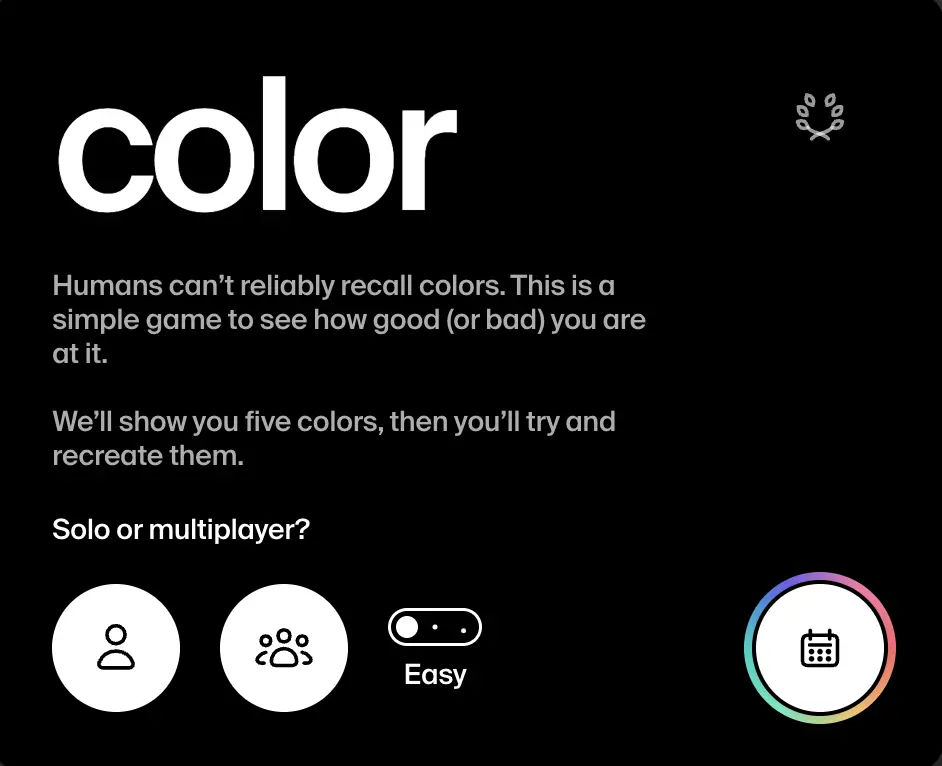
Color at color.method.ac is a free color matching game from Method of Action. Each round shows a target swatch and a color picker. You adjust hue and saturation until your match is as close as possible. Early levels isolate one dimension at a time — hue only, then saturation — before combining both. Later levels introduce harmony relationships where you match not just one color, but a color relationship.
The game includes screen calibration at the start and optional color-blind assistance that maps primary hues to distinct shapes. It runs entirely in the browser with no install, no account, and no paywall.
Why designers love it
| Benefit | What it means in practice |
|---|---|
| Hue and saturation separated | Early levels train one dimension at a time before combining them — the same mental model as HSB pickers in design tools |
| Harmony relationships taught | Complementary, analogous, triadic, and tetradic rounds teach color theory through doing, not reading |
| Screen calibration built in | Accounts for your display's color rendering before scored rounds begin |
| Color-blind assistance available | Optional mode maps hues to shapes so you can play regardless of color perception |
| Perceptual scoring | Rates matches from perfect to poor based on perceptual distance, not exact hex equality |
Play Color method — start matching →
How the Color method game works
The game progresses through several stages, each building on the last:
- Hue matching — The target swatch appears. Adjust only the hue slider to match it. This trains your eye for color family recognition.
- Saturation matching — Same target, but now you adjust only saturation. Train your eye to see how vivid or muted a color is.
- Hue + saturation combined — Both sliders are active. Match the target across both dimensions.
- Complementary harmony — A base color is shown. Pick the color directly opposite on the wheel.
- Analogous harmony — Pick colors adjacent to the base on the wheel.
- Triadic harmony — Three colors evenly spaced at 120° intervals. Match the missing two.
- Tetradic harmony — Four colors forming a rectangle on the wheel. Match the relationship.
Each round scores your match: perfect, very good, good, average, or poor. The scoring has built-in tolerance — near matches still earn high marks, which keeps the game encouraging rather than punishing.
Color guessing and matching tips
These strategies help you score higher in Color method and build color intuition that transfers to design tools.
1. Run calibration once per display
The game starts with a screen calibration step. Don't skip it. On wide-gamut monitors, dimmed laptop panels, or external displays, calibration corrects for the color shifts your screen introduces. A skipped calibration means your "perfect" match might be perceptually off.
2. Separate hue from saturation mentally
Early levels isolate one dimension at a time. Even in combined rounds, fix hue first — get the color family right — then dial saturation. This is the same order most pickers use in Figma, CSS, and design tools. Guessing both at once leads to overshooting.
3. Know your wheel positions for harmony rounds
The harmony levels test relationships, not memory of hex codes:
- Complementary: directly opposite on the wheel (180°)
- Analogous: neighbors on either side (usually 30° apart)
- Triadic: three colors at 120° intervals
- Tetradic: four colors forming a rectangle — two complementary pairs
If you can visualize the color wheel, harmony rounds become pattern recognition rather than trial and error.
4. Aim for "very good," not pixel-perfect
The scoring tolerates near matches. Micro-adjusting a slider by one pixel often drops a very good result to average because you overshoot. Once you see green, stop. Perfectionism in this color guessing game is the enemy of a good score.
5. Use color-blind assistance if hues blend together
Method of Action maps primary hues to distinct shapes in color-blind mode. Intermediate hues appear as morphs between shapes. You still fine-tune the color for the best score — the shapes just give you an additional visual anchor when hue alone is ambiguous on your display.
6. Drill the harmony type you struggle with
After a full session, note which harmony topic gave you the most trouble. Replay only those rounds. Matching color games build skills fastest when you drill one relationship type until it feels automatic, then move to the next.
Apply these tips in Color method →
From color matching to real design work
The skills you build in this color match game map directly to professional design tasks:
| Color game skill | Real-world application |
|---|---|
| Hue recognition | Picking the right brand color from memory during a client call without opening the style guide |
| Saturation judgment | Knowing when a button color is too vivid or too muted for the surrounding UI |
| Complementary pairing | Choosing call-to-action colors that pop against a brand's primary palette |
| Triadic and tetradic thinking | Building a cohesive color system with enough variation for charts, states, and data visualization |
| Screen-aware color picking | Understanding that colors shift across displays — and accounting for it before handoff |
After a few sessions of Color method, you'll stop guessing hex codes and start reasoning about color relationships. That's the difference between picking colors and designing with them.
Related color training tools
Color method covers harmony and matching. Pair it with these tools for a complete color skillset:
Color Recall
Where Color method teaches harmony via matching, Color Recall trains memory — memorize swatches, then recreate them with HSB strips. Many designers use both: Color method for theory, Color Recall for recall speed.
Hex Test
Guess hex codes from swatches across ten levels. After Color method builds your hue and saturation instinct, Hex Test adds the precision of reading and writing #RRGGBB values — the format developers hand you in specs.
Color Contrast Checker
When your color match session produces swatches you want to ship, validate text contrast against WCAG ratios. Matching a color is step one; making it accessible is step two.
Best Color Games for Designers
A full comparison of Color Recall, Color method, Hex Test, Pixactly, and Can't Unsee — which skills each one trains and how to combine them into a practice routine.
Frequently asked questions
Is this the Color method game from Method of Action?
Yes. Our Color method page embeds the official game at color.method.ac. All levels, scoring, calibration, and color-blind assistance run on the Method of Action platform. We provide the embed, tips, and quick reference.
Is Color method a color guessing game?
Yes. Every round is a form of color guessing — you adjust hue and saturation to match a target swatch or harmony relationship. The game scores how close your guess comes, from perfect to poor. It's practice, not a quiz with right-or-wrong answers.
What harmony topics does the color matching game cover?
The game teaches four harmony types: complementary (opposites on the wheel), analogous (neighbors), triadic (three at 120°), and tetradic (four forming a rectangle). Each round asks you to reproduce a color relationship, not just a single swatch.
How is Color method different from a color memory game?
Color method teaches harmonies while swatches stay visible during matching — you can see the target and adjust toward it. Color Recall hides colors after a timer and asks you to recreate from memory. Color method builds theory; Color Recall builds recall speed. Many designers use both.
How does the color match scoring work?
The game compares your selected color to the target using perceptual distance and rates the match: perfect, very good, good, average, or poor. Near matches earn high marks — you don't need to hit the exact hex code. The tolerance keeps the game encouraging while still rewarding precision.
Does Color method support color-blind players?
Yes. Method of Action provides optional color-blind assistance: primary hues are mapped to distinct shapes, with intermediate hues shown as morphs between shapes. You still fine-tune the color picker for the best score — the shapes add an extra visual anchor.
Do I need to calibrate my screen?
Strongly recommended. The game starts with a calibration step that accounts for your display's color rendering. Skipping it means your "perfect" match might be off due to your monitor, not your eye. Run calibration once per display you use.
Is the Color method game free?
Yes. You can play directly in the browser with no account, no download, and no paywall. Calibration, color-blind assistance, and all harmony levels are fully accessible.
What if the embed isn't loading?
Some browser settings or network restrictions can block third-party iframes. Try refreshing the page or switching browsers — our Color method page loads the official game directly so you can play with full calibration and scoring.
What's next after mastering hue and saturation?
Once color matching feels intuitive, move on to memory-based color training with Color Recall, the full Dialed suite guide, hex code fluency with Hex Test, and accessibility validation with the Color Contrast Checker. Each tool targets a different layer of color proficiency.
Color matching isn't a talent you're born with — it's a skill you train. After a few sessions of Color method, you'll read a brand palette and know which harmony type it uses. You'll pick complementary colors for a CTA without opening a wheel tool. And you'll stop second-guessing saturation levels in client reviews. Start matching colors now →
Enjoyed this story? Share it or follow on Google.