- Impeccable
- Impeccable Skill
- Claude Code
- Frontend Design
Impeccable Skill Guide: Frontend Design for Claude & Agents
What the Impeccable design skill is, how it differs from a generic Anthropic frontend design skill, and how to install it for Claude Code, Cursor, and other agents.

Sherotree
·8 min read
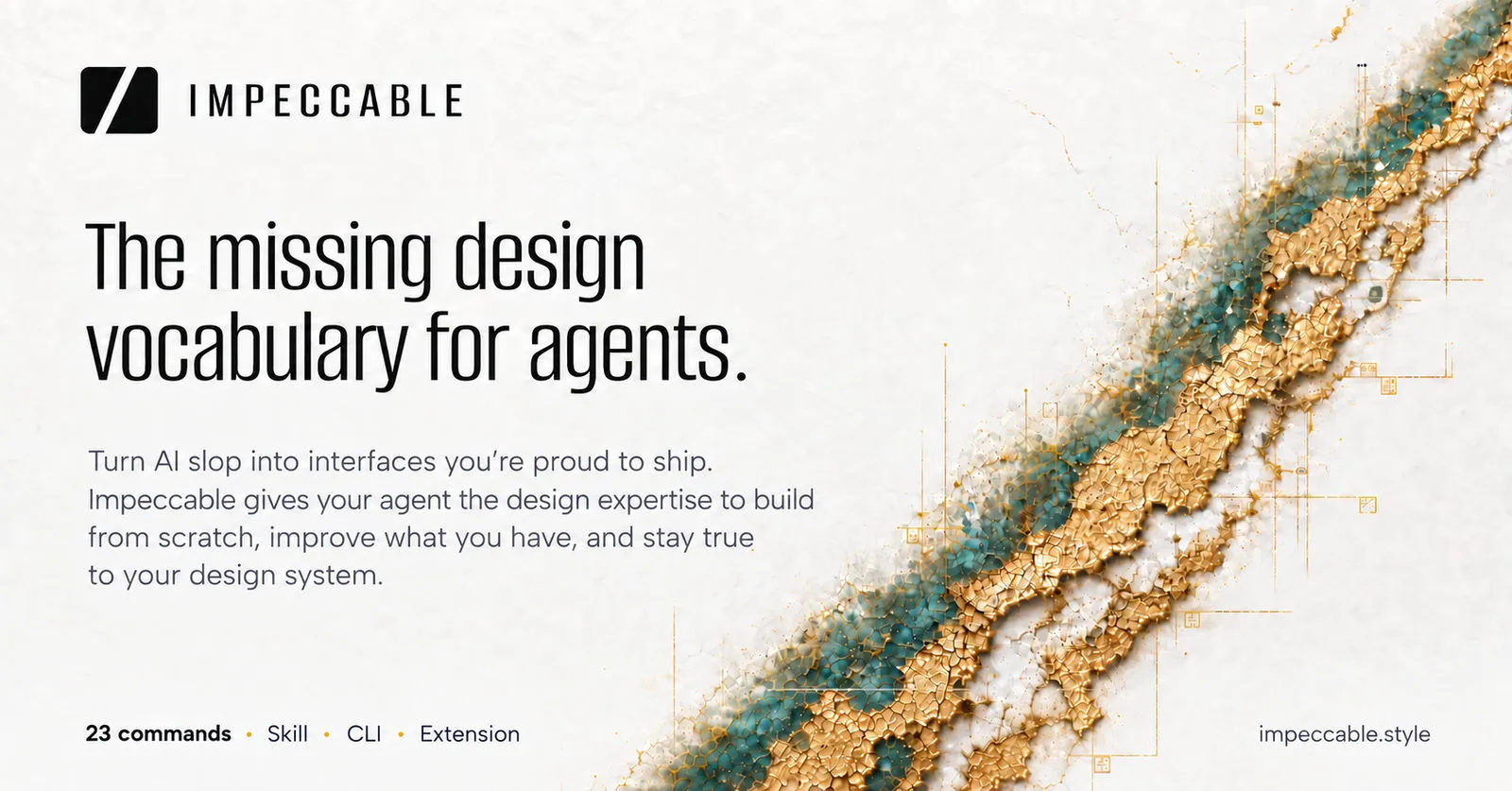
Impeccable is a free impeccable skill (and broader impeccable design skill pack) for coding agents. It gives Claude Code, Cursor, GitHub Copilot, Codex, and similar tools a shared design vocabulary—so agents can build UI, polish what you already have, and stay inside your design system instead of inventing “AI beige” defaults.
If you only need a short product snapshot with outbound links, start with our curated page: Impeccable overview. This guide goes deeper on install, commands, DESIGN.md / PRODUCT.md, and when to skip Impeccable AI for a hosted builder.
Official entry points:
- Product site: impeccable.style
- Source: github.com/pbakaus/impeccable
- Typical install:
npx impeccable install
Why “impeccable style” matters for agent UI
Coding agents are excellent at wiring features and mediocre at visual craft. Without guidance they reuse the same tells: soft purple gradients, italic display serifs fighting body copy, equal-weight cards, pulsing status dots, and hierarchy where every element shouts.
Impeccable style is the product’s answer: teach the agent what good looks like for the job (persuade on a landing page, operate in a dashboard, read long content), then enforce it with:
- Slash commands (
/impeccable polish,typeset,distill,audit,live, …) - Project context files (
DESIGN.md,PRODUCT.md) - A code-side detector that flags dozens of AI-slop patterns—often without an extra model API call
That combination is why people search for impeccable skill Claude or impeccable skills after trying one-off “make this prettier” prompts that do not stick across sessions.
Impeccable vs a generic Anthropic frontend design skill
Search results for anthropic frontend design skill usually mean a prompt pack or skill file that nudges Claude toward better UI. Impeccable overlaps with that intent, then goes further:
| Need | Lean toward |
|---|---|
| One-shot “improve this React page” prompt | A generic frontend design skill or paste-in instructions |
| Repeatable commands across Claude Code, Cursor, Copilot, Codex | Impeccable |
| Persist brand rules and user goals between features | Impeccable + DESIGN.md / PRODUCT.md |
| Catch AI-slop defaults as the agent edits | Impeccable detector / audit flows |
| Hosted chat-to-UI with no agent install | Tools like v0 or Lovable |
Treat Impeccable as agent infrastructure for design, not a Figma replacement and not a full app builder. If your daily driver is already an AI editor, pair this skill with Cursor. If you want a local design workspace that outputs files via agents, compare Open Design.
What you get when Impeccable works
A healthy setup typically gives you:
- Tool-specific install — file locations and guidance matched to Claude Code, Cursor, Copilot, Codex CLI, Gemini CLI, and other listed agents
- Command surface — polish (quality pass), typeset (hierarchy and measure), distill (strip noise), audit / harden, onboard, system helpers (
init,extract,document), and live mode against a running app - System respect — reads tokens, Tailwind theme extensions, and component folders so new screens feel like the same product
- Slop detection — checks for competing titles, status-chip soup, clipped labels, weak contrast, and other defaults agents keep reaching for
- Optional extras — Chrome DevTools panel and CLI checks you can wire into PRs
The durable artifact is not a screenshot. It is source written back into your repo, with findings you can re-run after the next edit.
Step 1 — Install the impeccable skill
Pick the installer that matches your agent. On the official site, the common paths are:
npx impeccable installClaude Code marketplace style:
/plugin marketplace add pbakaus/impeccableThen open /plugin, Discover, and install Impeccable.
Shared skills entrypoint (when you standardize across tools):
npx skills add pbakaus/impeccableGitHub Copilot users: Impeccable may ship as an experimental / built-in path—enable it in settings per the live docs, then set up the project.
Update later with npx impeccable update (or the matching /plugin / npx skills update impeccable flow for your host). Prefer one install story per machine so skills cannot drift across agents.
Step 2 — Initialize DESIGN.md and PRODUCT.md
Before asking for a landing-page redesign, give the agent durable context:
/impeccable initOr document / extract from what already exists. Aim for:
- PRODUCT.md — who the users are, what job the screen must do, accessibility constraints (for example: outage responders on a phone; keep alerts readable)
- DESIGN.md — colors, type scale, radii, brand rules, component variants the agent must reuse
Without those files, Impeccable still helps—but every session re-learns your product from scratch. With them, polish passes stay on-brand and task-focused.
Step 3 — Run a concrete design command
Describe the change in job language, then name the command:
/impeccable polish the pricing page. Keep sharp corners and our sober palette. Remove AI tells.Good prompts:
- State constraints (palette, radius, existing components)
- Name the job (persuade, operate, read)
- Ask for a detector pass before handoff
Avoid vague prompts like “make it beautiful.” Agents already invent beauty; Impeccable is for controlled craft.
Live mode
When the app is running locally, live mode can open the page, inject a picker, and wait for element-level or page-level steering. Use it when screenshots are too slow and you want the agent tied to production source files—not a disconnected mock.
Step 4 — Fix P0 findings first
The detector ranks issues. Treat P0 (for example a missing visible label on an email field) before polishing spacing. A useful habit:
- Agent edits UI
- Detector reports findings
- Agent fixes and re-checks
- Stop when findings hit zero—or when remaining items are intentional brand choices documented in
DESIGN.md
That loop is the difference between “we vibe-coded until it looked okay” and “we have a checklist that survives the next feature.”
When to use Impeccable AI—and when to skip it
Use Impeccable AI / the impeccable design skill when:
- You ship UI through Claude Code, Cursor, or another supported agent
- You already have (or will create) a design system worth protecting
- You need repeatable polish, not a one-time Figma dump
- Free install matters and you already pay for model/agent usage elsewhere
Skip it when:
- You want a hosted canvas with no skill install
- You need brand-new marketing art or illustration (wrong tool class)
- Nobody on the team will maintain
DESIGN.md/PRODUCT.md—without context, results regress toward generic taste
For UI kits and component discovery, browse 21st.dev. For AI UX generation products, see UX Pilot. Keep Impeccable for the agent-in-the-repo path.
Practical tips
- Install for the agent you actually use daily — tool-specific builds encode different model failure modes
- Document before you polish — five minutes of
DESIGN.mdbeats twenty minutes of undo - One primary action per screen — when polish and typeset disagree, hierarchy wins
- Verify after approval — if you publish a case study site built with Impeccable, review accessibility and performance yourself; the skill is not a WCAG auditor
- Point teammates at the short page first — share Impeccable, then this guide for install depth
FAQ
What is the Impeccable skill?
Impeccable is a free frontend design skill for AI agents. It installs into tools such as Claude Code and Cursor, exposes design slash commands, and can detect common AI-slop UI patterns while respecting your design system.
Is Impeccable free?
Yes. The skill and installers are free on impeccable.style. You still pay for the coding agent and model usage you already use.
Does Impeccable work with Claude Code?
Yes. People searching impeccable skill Claude usually want the Claude Code marketplace or plugin path. Confirm the live install snippet on the official site—commands evolve with the project.
How is Impeccable different from other impeccable designs or prompt packs?
“Impeccable designs” as a search phrase often means pretty outputs. The product is a skill system: commands, context files, multi-tool installers, and a detector. Prompt packs rarely persist brand rules across months of features.
Where should I send a short summary?
Use the curated overview: Impeccable. Use impeccable.style and the GitHub repo for installers, docs, and issues.
Next steps
- Install with
npx impeccable install(or your agent’s marketplace path) - Run
/impeccable initand fillPRODUCT.md+DESIGN.md - Polish one real page, then clear detector findings
- Skim Impeccable on Uwarp, then return to the official docs for live-mode and CI setup
Impeccable will keep shipping commands and checks. The durable idea is simple: give agents a design vocabulary, store decisions in the repo, and refuse to ship the same AI-slop defaults twice.
Enjoyed this story? Share it or follow on Google.